Environmental and Historical Interpretive Signage Quiet Waters Park
About This Urban Oasis
The Friends of Quiet Waters Park Environmental Committee’s years-long collaboration with Save Our Trees, a local non-profit, resulted in a highly successful effort by Annapolis High School students to create an “Urban Oasis” within the park. Over the course of two years, over 75 students dug up, cut down and wrangled all kinds of invasive plants. The Friends provided gloves and tools for this extremely difficult work! Students then returned in the spring to replant the area with native plants provided by the Friends and Save Our Trees.
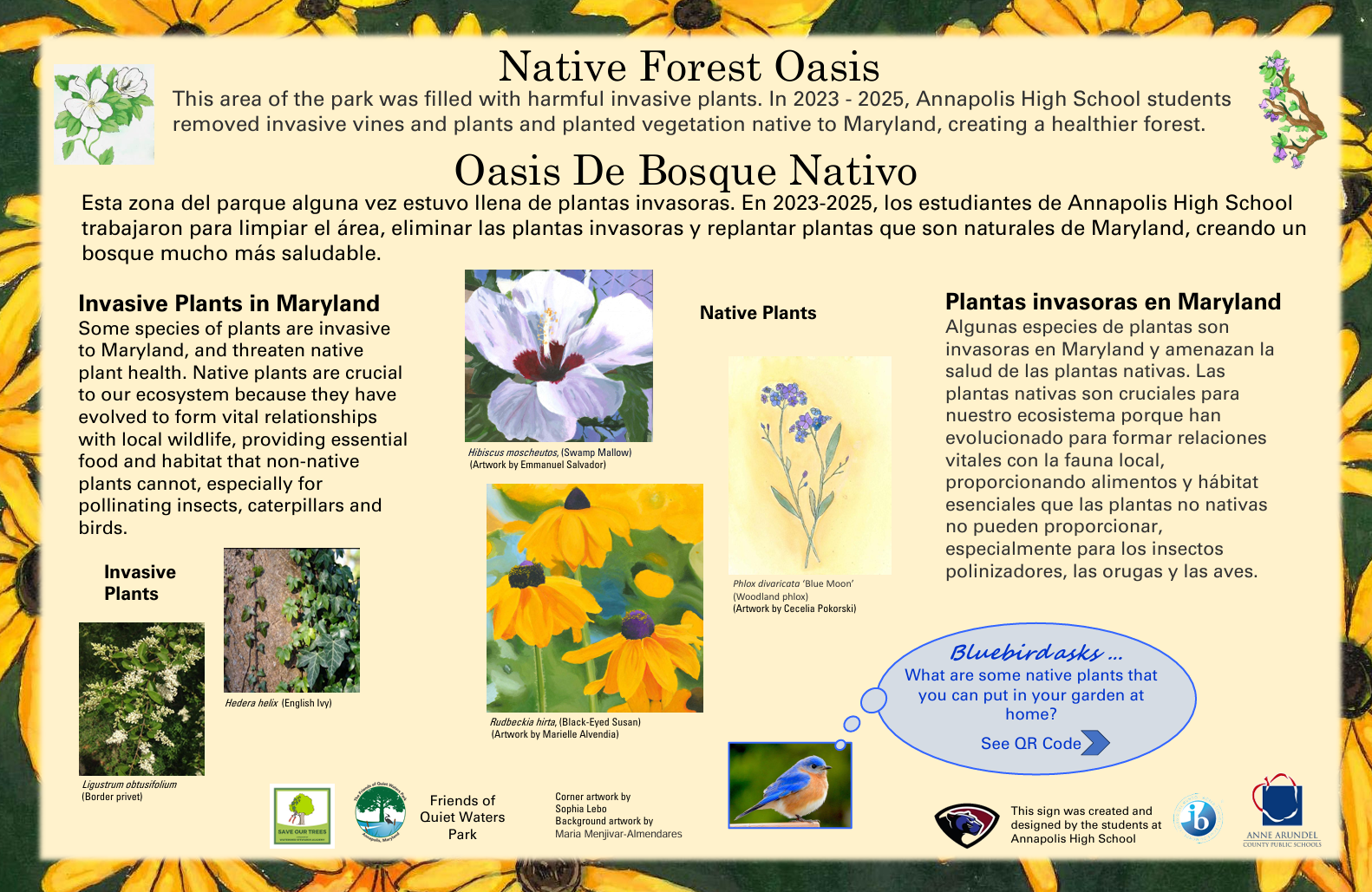
Art students at Annapolis High created permanent signage that tells the story of the transformation of the area to all who pass by! The creation of the oasis showcases the threat of invasives and importance of native plants as well as the students’ very important contribution to the restoration of the natural environment. The energy and commitment of the students inspired everyone involved with the project!
What invasive plants did the students remove? What has been planted to re-naturalize the area?
Before replanting could begin, students removed huge amounts of English Ivy, Privet, Japanese Honeysuckle, wineberry, bittersweet, vinca, euonymus and barberry. Some of these plants are still available for sale at local nurseries despite their negative impact on our environment!
Students planted over 100 perennials as well as more than 75 shrubs both to the right and to the left of the restrooms. These included native plants that are generally easy to find in our local nurseries and do well in our specific environment:
Perennials: Ferns, packera, woodland aster, sedges, Indian Pink and bluebells.
Shrubs: Serviceberry, Carolina Allspice, Native Euonymus, Pinkster Native Azalea, Oakleaf hydrangea.
Why is this important?
The long-term health of Quiet Waters Park (and all our urban forests) is dependent on its biodiversity, which is key to supporting the local ecosystem. Invasive plants, many of which have escaped from nearby yards and spread by birds, overtake native plant populations and threaten entire food webs.
Managing the invasive species in Quiet Waters Park and all of Anne Arundel County has become a serious issue, with significant costs to homeowners, county parks, highway administrations and farmers. Invasives threaten the very health of our ecosystem.
Removing invasives from county parks and planting natives in your yard are two important ways to help protect our urban forest.
Why are native plants so important?
A native species is one that occurs naturally in a particular placed without human intervention. Species native to North America are generally recognized as those occurring on the continent prior to European settlement.
Native plants have a huge impact on local wildlife, our climate and of course all of us.
Native plants:
- Are the foundation of the entire food web that all animal life relies on.
- Support birds, pollinators and other wildlife that are under increasing stress from invasive species, development, and climate change. Native plants provide the best possible habitat for native wildlife.
- Are essential host plants for many insects, including the caterpillars of butterflies and moths which themselves are an extremely important part of a healthy ecosystem. web as well as pollinators.
- Often have deeper root systems which help reduce watering needs, manage rainwater runoff, and maintain a healthy soil structure.
- Are less prone to pest problems that may require toxic chemicals that can enter our ecosystems and waterways.
- Provide a sense of place and space that ties our gardens to the unique regional natural history of the land where we live.
Native Plant Resources
To learn more about what native plants do well in our area, visit one or more of the following sites:
University of Maryland Extension
Recommended Native Plants for Maryland
https://extension.umd.edu/resource/recommended-native-plants-maryland/
Maryland Native Plant Society
Landscaping with Native Plants
https://mdflora.org/resources/Publications/GardenersGuidelines/Landscaping-Natives.pdf
US Fish and Wildlife Service
Native Plants for Wildlife Habitat and Conservation Gardening
https://dnr.maryland.gov/criticalarea/Documents/chesapeakenatives.pdf
Maryland Department of Natural Resources
Creating a Wild Backyard – Hummingbirds, Butterflies & Bees
https://dnr.maryland.gov/wildlife/pages/habitat/wahumbutbee.aspx
National Wildlife Federation
https://nativeplantfinder.nwf.org/
What is an invasive plant?
Non-native plants are species that have not existed historically in one area but have been introduced due to human activities. Invasive plants are non-native species that have escaped cultivation, disrupted local ecosystems, and degraded biodiversity. Invasive plants disrupt the growth of native plants, and root and spread quickly. Invasive plants do not support the local ecosystem, providing little to no food or habitat for native insects and birds.
These plants thrive because they lack natural predators (insects/diseases) and are ignored by overabundant deer, allowing them to crowd out important native plants that support local food webs.
Invasive Plants in Maryland:
https://extension.umd.edu/resources/yard-garden/weeds/invasive-plants/
Get involved!
If you are interested in helping rid Quiet Waters Park of invasive plants, volunteer at Friends of Quiet Waters Park: https://fqwp.org/volunteer/